
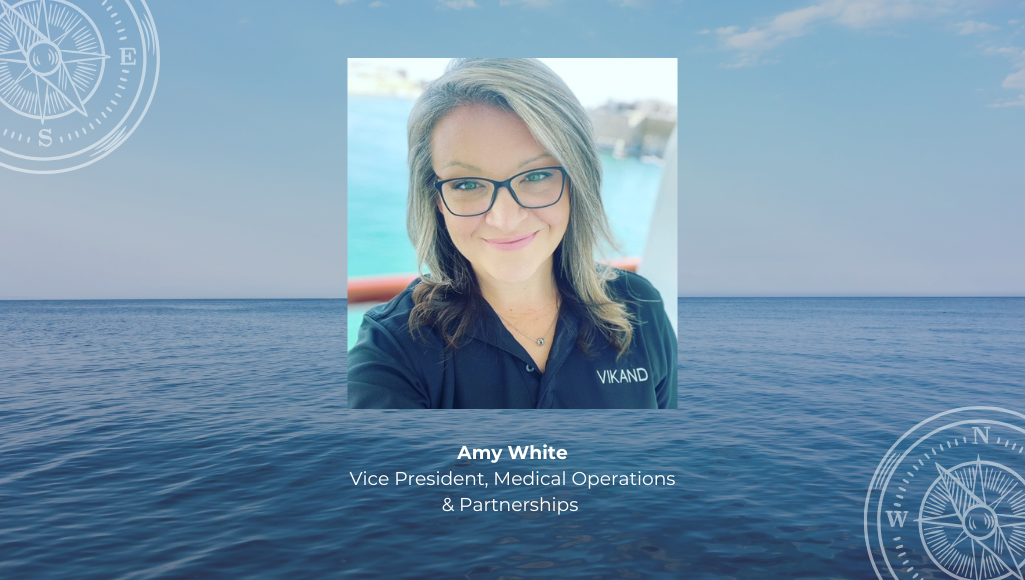

VIKANDER Profile: Amy White, VP Medical Operations and Partnerships
This month, we spoke with Amy White, an experienced maritime nurse who joined VIKAND more than a decade ago. Since then, she has progressed into senior leadership and now plays a key role in guiding the organisation’s global medical operations.
What do you do in your current role at VIKAND?
As Vice President of Medical Operations and Partnerships, I lead a team of six Medical Managers and oversee our client partnerships, mainly in the passenger cruise sector. My focus is on the strategic and day-to-day delivery of onboard medical services, making sure everything is consistent, compliant and operating to a high standard across the fleet.
That includes standardising protocols, supporting new builds, managing formularies and ensuring we have the right people in place. Ultimately, my role is about making sure every onboard medical centre runs safely and efficiently while meeting both regulatory requirements and client expectations.
What has been your career experience in the maritime sector?
I started my maritime career in 2013 with Royal Caribbean followed by additional contracts with Celebrity Cruises. In 2015, I joined VIKAND as a Lead Nurse on Viking Ocean Cruises and have been here ever since.
Over time, I advanced through several roles, from Fleet Nurse to Vice President. It has been a journey of growing alongside the organisation, with increasing responsibility across both operational leadership and client engagement.
What’s a career highlight that you are particularly proud of?
Being appointed Director of Medical Operations was a defining moment for me. It gave me the opportunity to have a broader impact on both patient care and team development. I’m especially proud of our advocacy for onboard medical teams, making sure they feel confident and supported in highly demanding roles.
I’ve also gained experience in building and operationalising medical centres from the ground up, which is not something typically covered in clinical training. Contributing to VIKAND’s growth from a small organisation into a globally connected operation has been incredibly rewarding.
From your perspective, what’s been the biggest advancement in maritime healthcare?
The evolution of real-time communication and telehealth has been transformative. Onboard medical teams can now connect instantly with shoreside clinicians and specialists through video consultations, enabling faster decision-making and better patient outcomes. Earlier in my career, that level of connectivity simply was not there, which often meant delays in getting support.
Who has made a significant impact in your area of the industry?
To me, the biggest impact comes from onboard medical teams themselves. They are on the frontline, delivering care in complex and often resource-limited environments.
Their professionalism, adaptability and commitment to patient safety uphold the standards VIKAND represents. They’re not just operationally critical, but also strong ambassadors for the organisation and the wider maritime healthcare industry.
What is the biggest challenge in your role and how do you address it?
One of the biggest challenges is balancing risk mitigation with cost efficiency. Improving onboard medical capabilities – whether by upgrading facilities or expanding services – requires investment, but those improvements are essential to safety and resilience.
Addressing that balance comes down to clear communication, data-led decisions and proving long-term value. By aligning clinical priorities with business objectives, I work closely with stakeholders to achieve sustainable outcomes.
How important is support from organisations such as VIKAND?
Support from organisations like VIKAND is essential for delivering safe and consistent healthcare at sea. The maritime environment is uniquely challenging, and strong shoreside support gives onboard teams the guidance, resources and reassurance they need.
Our clients can feel confident that their medical operations are managed to a high standard, with a clear focus on safety, compliance and efficiency. This enables medical professionals to focus on patient care while maintaining overall operational reliability.
What advice would you give to someone considering a career in shipping?
Strong clinical skills are important, but just as critical are teamwork, cultural awareness and problem-solving. It is a fast-paced and sometimes unpredictable environment, so adaptability and resilience go a long way. At the same time, it offers unique opportunities for travel, professional growth and personal development that are hard to find elsewhere.
Where do you live and what makes it special?
I live in Johannesburg, South Africa – a place known for its diversity, energy and natural beauty. What makes it special to me is the balance it offers, from incredible landscapes to a strong sense of community and family life.
What do you enjoy in your leisure time?
I enjoy running, which helps me stay active and maintain balance in a busy role. Most importantly, I value spending time with my family, especially with my 9-month-old son. Being present for those moments is incredibly important to me.